
Home › Forums › MISCELLANEOUS POSTS › MISCELLANEOUS POSTS › TASTE BUDS DON’T AFFECT TENDENCY FOR SWEET TOOTH
Welcome Dear Guest
To create a new topic please register on the forums. For help contact : discussdentistry@hotmail.com
- This topic has 2 replies, 1 voice, and was last updated 27/12/2011 at 4:27 pm by
 drmithila.
-
AuthorPosts
-
27/12/2011 at 4:20 pm #10231
 drmithila
OfflineRegistered On: 14/05/2011Topics: 242Replies: 578Has thanked: 0 timesBeen thanked: 0 times
drmithila
OfflineRegistered On: 14/05/2011Topics: 242Replies: 578Has thanked: 0 timesBeen thanked: 0 timesThere’s no link between what one perceives as sweetness and what the person actually eats. In other words, it’s plausible that the more aware a person is to sweet tastes that the less sweet food he or she may eat.
The information was reported by a research team at Deakin University in Melbourne, Australia.
The goal of the study was to determine the level of sweets a person consumes based on how sensitive he or she is to sweets.
To gather the data, the research team studied 85 people and asked them the level of sweetness of a sucrose solution. The researchers then studied the dietary intake over several days.
The research team specifically looked at the amount of sugary foods the people ate compared to the number of fruits and vegetables, in addition to carbohydrates, protein and fat.
One issue with this study was that many people fit the same demographic. In future research on this subject, there will be a wider variety of people based on age, ethnicity, BMI, etc.
A person would need to find a way to get sweet foods out of his or her mind to successfully avoid eating such foods. It could be helpful to consistently eat healthier foods as a way of getting sweet foods completely of your mind.
More research is necessary involving the cause of the sweet tooth since this research showed that there’s no correlation between one’s awareness level of sweet foods and the amount of sweet foods the person consumed.
27/12/2011 at 4:27 pm #15009drmithila
OfflineRegistered On: 14/05/2011Topics: 242Replies: 578Has thanked: 0 timesBeen thanked: 0 timesTaste buds contain the receptors for taste. They are located around the small structures on the upper surface of the tongue, soft palate, upperesophagus and epiglottis, which are called papillae.[1] These structures are involved in detecting the five (known) elements of taste perception: salty,sour, bitter, sweet, and umami. Via small openings in the tongue epithelium, called taste pores, parts of the food dissolved in saliva come into contact with taste receptors. These are located on top of the taste receptor cells that constitute the taste buds. The taste receptor cells send information detected by clusters of various receptors and ion channels to the gustatory areas of the brain via the seventh, ninth and tenth cranial nerves.
On average, the human tongue has 2,000–8,000 taste buds
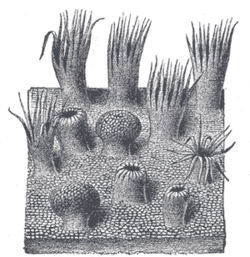
The majority of taste buds on the tongue sit on raised protrusions of the tongue surface called papillae. There are four types of papillae present in the human tongue:
- Fungiform papillae – as the name suggests, these are slightly mushroom-shaped if looked at in longitudinal section. These are present mostly at the apex (tip) of the tongue, as well as at the sides. Innervated by facial nerve.
- Filiform papillae – these are thin, long papillae "V"-shaped cones that don’t contain taste buds but are the most numerous. These papillae are mechanical and not involved in gustation. They are characterized by increased keratinization.
- Foliate papillae – these are ridges and grooves towards the posterior part of the roof of the mouth found on lateral margins. Innervated by facial nerve (anterior papillae) and glossopharyngeal nerve(posterior papillae).
- Circumvallate papillae – there are only about 10 to 14 of these papillae on most people, and they are present at the back of the oral part of the tongue. They are arranged in a circular-shaped row just in front of the sulcus terminalis of the tongue. They are associated with ducts of Von Ebner’s glands, and are innervated by the glossopharyngeal nerve.
It is generally accepted that there are five taste sensations:
- Sweet, bitter, and savory (now sometimes called umami), which work with a signal through a G protein-coupled receptor.
- Salty and sour, which work with ion channels.
[]Localization of taste and the specious "tongue map"
Contrary to popular understanding that different tastes map to different areas of the tongue, taste qualities are found in all areas of the tongue, although some regions are more sensitive than others.[3][4]
[]Structure of taste buds
Each taste bud is flask-like in shape, its broad base resting on the corium, and its neck opening, the gustatory pore, between the cells of the epithelium.
The bud is formed by two kinds of cells: supporting cells and gustatory cells.
The supporting (sustentacular) cells are mostly arranged like the staves of a cask, and form an outer envelope for the bud. Some, however, are found in the interior of the bud between the gustatory cells.
The gustatory (taste) cells, a chemoreceptor, occupy the central portion of the bud; they are spindle-shaped, and each possesses a large spherical nucleus near the middle of the cell.
The peripheral end of the cell terminates at the gustatory pore in a fine hair filament, the gustatory hair. Some early experimental studies (Kirk and Grills, 1992)it was shown that subjects who were genetically predisposed to baldness were found to be 78% more likely to experience taste loss sensations in 5 out of 5 taste trials.It was hypothesized that this was due to ‘balding’ of the tongue.
The central process passes toward the deep extremity of the bud, and there ends in single or bifurcated varicosities.
The nerve fibrils after losing their medullary sheaths enter the taste bud, and end in fine extremities between the gustatory cells; other nerve fibrils ramify between the supporting cells and terminate in fine extremities; these, however, are believed to be nerves of ordinary sensation and not gustatory.
The average life of a taste bud is 10 days.
27/12/2011 at 4:27 pm #15010drmithila
OfflineRegistered On: 14/05/2011Topics: 242Replies: 578Has thanked: 0 timesBeen thanked: 0 times -
AuthorPosts
- You must be logged in to reply to this topic.