Think of a patient whose scaling you finished six months ago. Did anyone call them back?
In most clinics the honest answer is “no, we meant to.” The treatment was done well. The patient simply drifted away, and so did the next visit.
A recall system does not need software to begin. These 10 habits are enough:
- Before the patient leaves, say when the next visit is due.
- Write the due date and the reason in the file.
- Keep one recall list, sorted by month.
- On the 1st of every month, pull that month’s list.
- Call or WhatsApp the same week, not “when free”.
- Say what the visit is for, not just “come for a check-up”.
- Note the reply: booked, later, not reachable.
- Try twice, on two different days.
- Move unreachable patients to a “call again in 3 months” list.
- Give one person the job, by name.
Why it is worth the trouble: a Cochrane review (2013, general healthcare appointments, not only dental) found attendance of 78.6% with text-message reminders against 67.8% with none. Phone calls did about as well (80.3%), so a short WhatsApp or SMS is a fair start.
The weak point of paper is that a register only works when someone opens it. The month you are busiest is the month it gets skipped.
I am a practising dentist, and I built Enamel because I wanted recalls to come to me instead of waiting in a register. I set the recall when I finish treatment, and the list of who is due is ready in the software. It runs on one clinic computer, not as a cloud app, and works offline (sending WhatsApp needs the internet). Happy to show it to anyone who is curious.
My question to you: who owns recalls in your clinic, and what do you do for the patients who never answer?
Dr. Yatin Shinde, BDS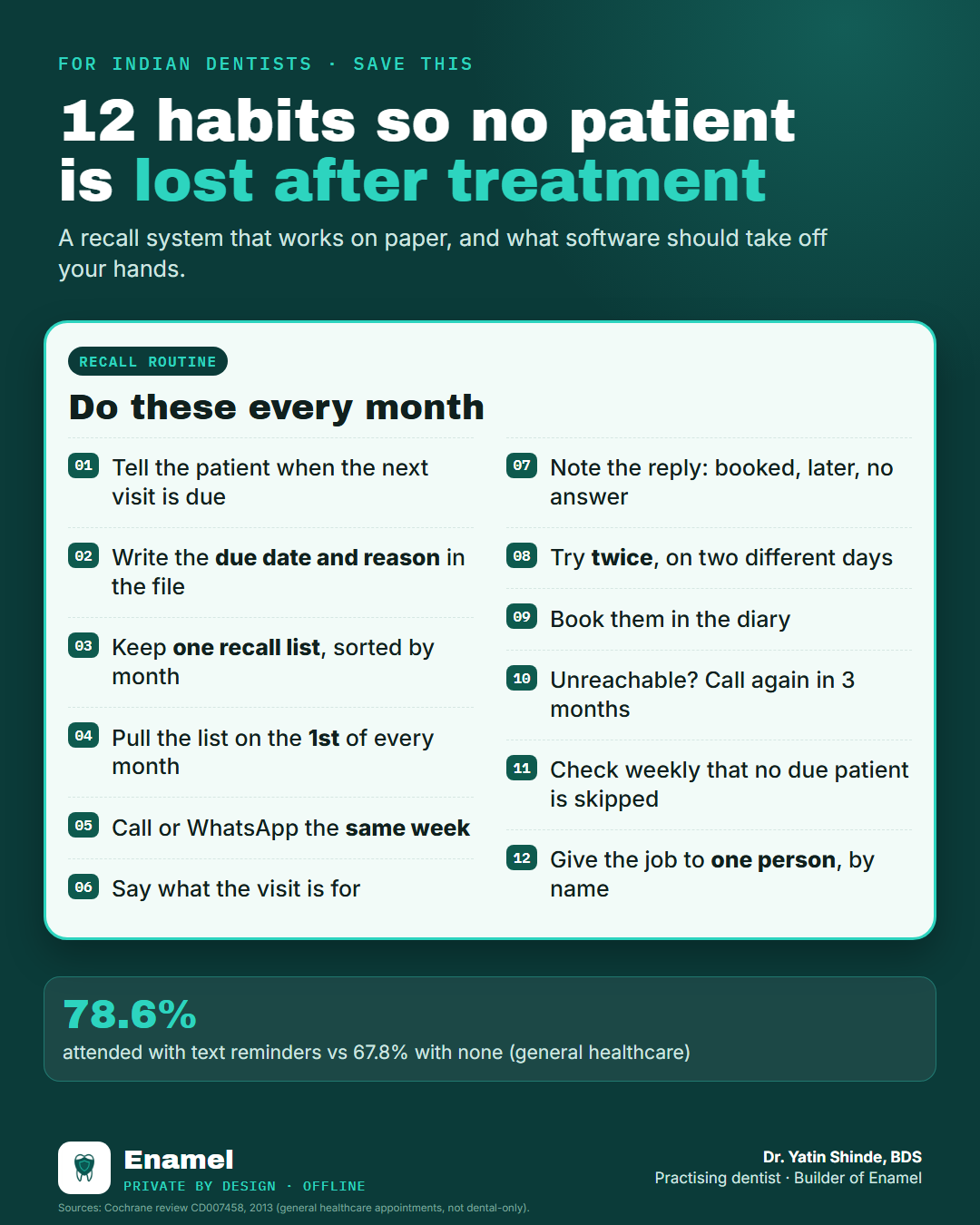

.

